Advantages and Disadvantages of River Transport in Logistics

River transport is still underused in practice, even though it is a very important factor in planning modern logistics chains.

River transport enables lower costs per ton, significant capacity and stable delivery, but it also comes with limitations in speed, seasonal dependence and the need for developed infrastructure. This mode of transport works well for bulk cargo over longer distances, while for urgent deliveries or areas without navigable waterways it is not an ideal solution. Below we explain in more detail the specific aspects and circumstances under which this choice becomes justified.
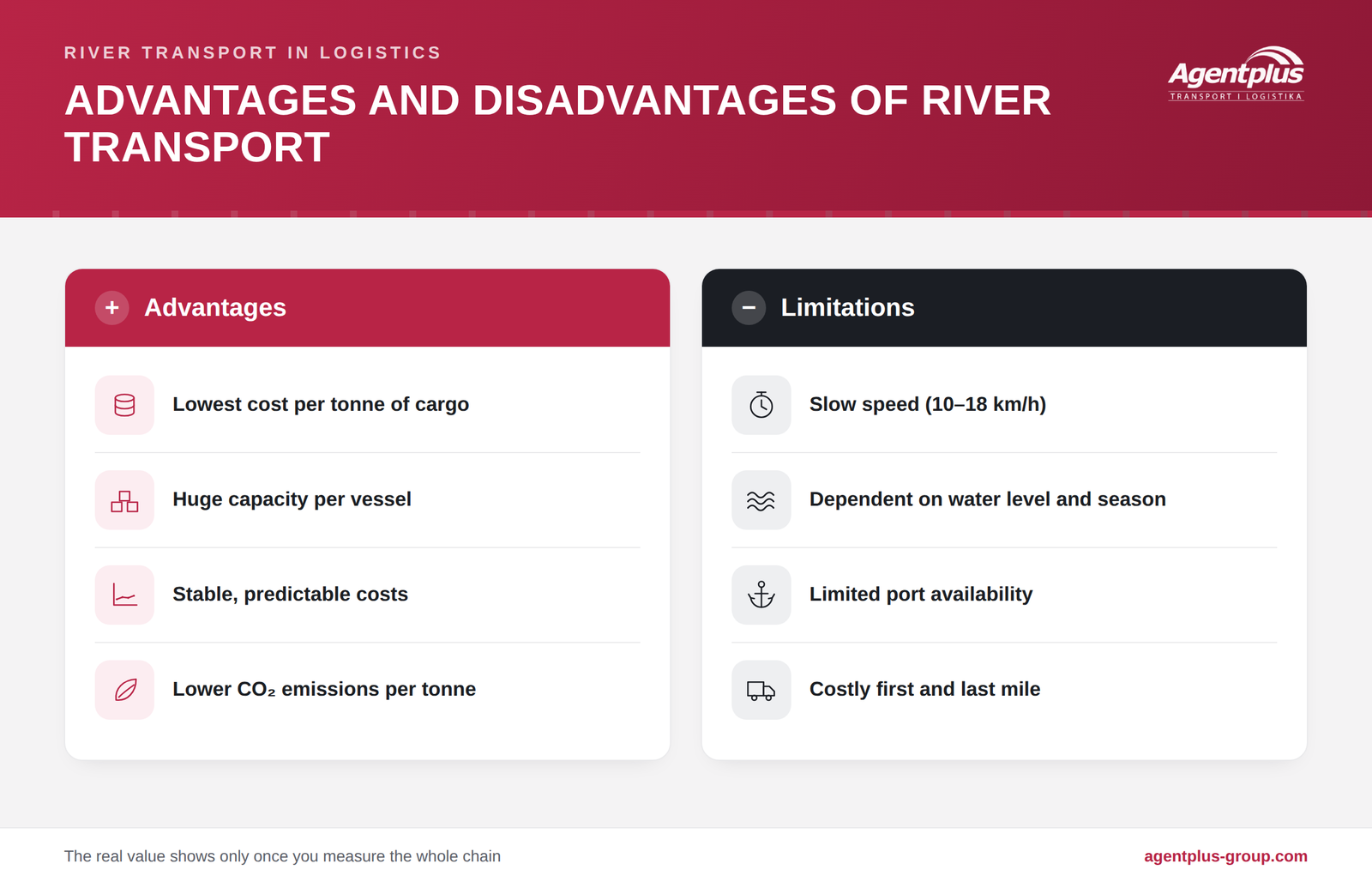
Infographic showing the advantages and disadvantages of river transport; advantages: lowest cost per tonne, huge capacity, stable costs and lower CO2 emissions; limitations: slow speed, dependence on water level, limited port availability and costly first and last mile

Advantages of river transport

Before you decide on river transport, it is important to understand what sets it apart from other modes and how those differences affect costs, delivery times and operational risks.

Key characteristics of river transport

This mode of transport is usually used for bulk and heavy cargo such as grain, ore, construction materials, industrial equipment and energy products. Several basic characteristics determine how it is planned:

  • high capacity of individual vessels
  • stable and predictable costs
  • slower speed compared to road and rail transport
  • sensitivity to water levels and seasonal changes
  • the need for specialized transshipment infrastructure

The combination of these factors shows whether a stable schedule and a competitive price can be achieved on a specific river route.

Where the real savings come from

The most pronounced advantage of river transport lies in the ratio between capacity and cost. When comparing the price of transporting one ton of goods, barges in many cases offer the lowest price per kilometer. This brings two concrete benefits to logistics plans: lower direct costs and the ability to consolidate cargo in larger quantities.

A practical example is the export of grain from northern Serbia. Once the grain is loaded onto a barge on the Danube, the cost of transport to ports in Romania or Bulgaria often drops by up to 40% compared to truck transport, depending on the seasonal demand for road capacity.

Delivery stability and route predictability

Although river transport is slower, the delays that occur on road routes due to traffic congestion, driver shortages, movement bans and similar issues rarely happen. This makes it exceptionally reliable in industries where transit time is not decisive, but stability is key.

The differences are most visible in the steel and construction materials industries, where barges often function as mobile warehouses. Planning becomes simpler because routes and costs remain consistent throughout the navigation season.

Limitations of river transport

When analyzing the advantages and disadvantages of river transport, three main limitations stand out in practice:

1) Speed

River transport is among the slowest modes of inland transport. Barges move at a speed of 10 to 18 km/h, and even slower on some sections. This means this mode of transport is not suitable for urgent deliveries or products with a short shelf life.

2) Water levels and seasonality

The water level directly determines the draft depth and loading capacity. During the summer, when the water level is often low, barges can sometimes carry only 50 to 70% of standard capacity. In winter, the problem is ice.

For this reason, many companies plan key deliveries during periods of stable water levels and use combined transport for critical stock.

3) Limited port availability

River transport works only where there are ports, transshipment ramps and appropriate access infrastructure. If a factory or warehouse is not near a waterway, the costs of the first and last mile can cancel out all the savings.

When river transport is the best choice
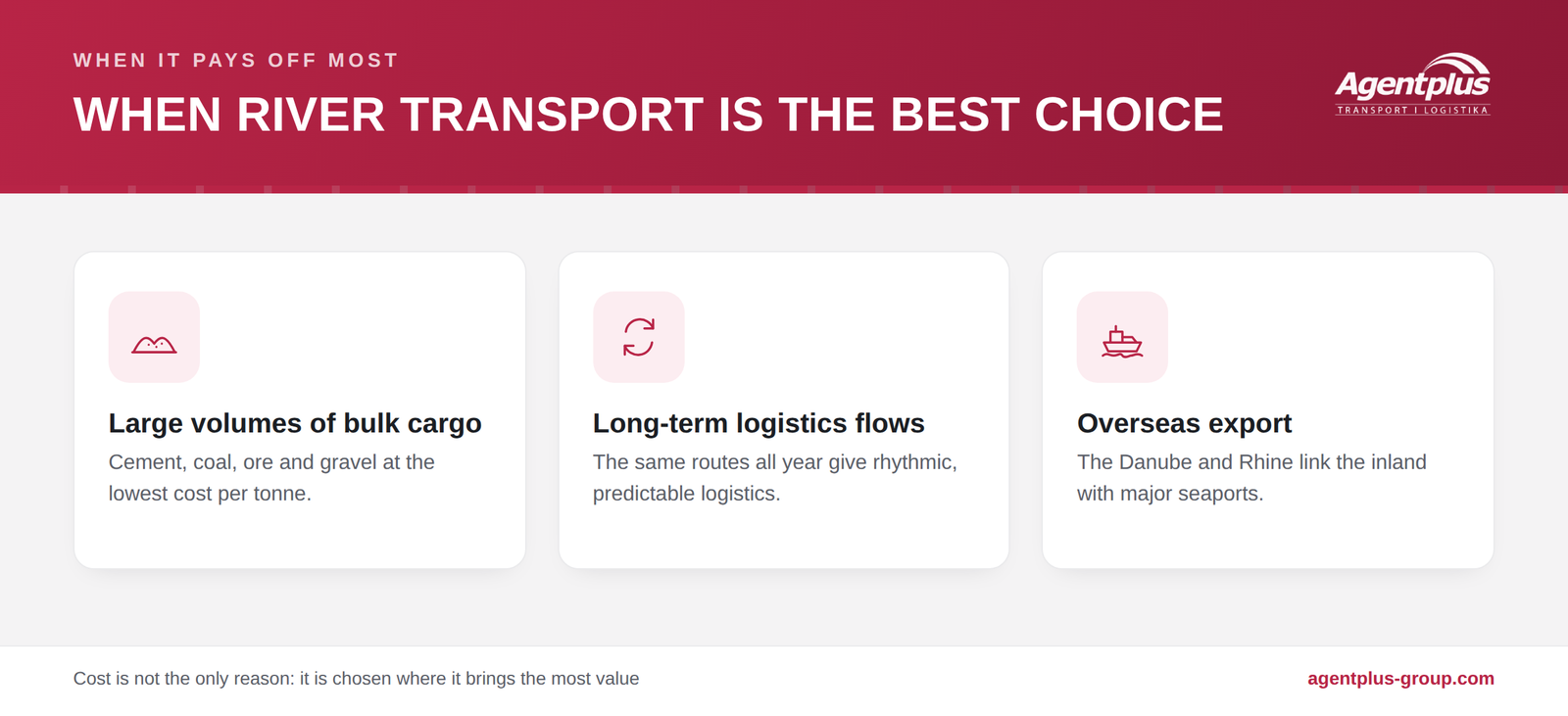
Infographic on when river transport is the best choice: large volumes of bulk cargo, long-term logistics flows, and overseas export via river corridors

Price is not the only reason river transport is chosen. There are clearly recognizable situations in which it provides the greatest value:

Large quantities of bulk cargo

Barges can carry thousands of tons in a single trip, which gives a better price-to-capacity ratio than any other mode of transport. For products such as cement, coal, ore or gravel, river transport almost always leads to the lowest price per unit of cargo.

Long-term logistics flows

Products that move along the same route throughout the year, for example industrial raw materials, work best on rivers because the logistics become rhythmic and predictable.

Overseas export via river corridors

The Danube, the Rhine and similar waterways connect the interior of the continent with major sea ports. River transport here serves as an economical extension of the maritime chain.

How river transport is combined with other modes
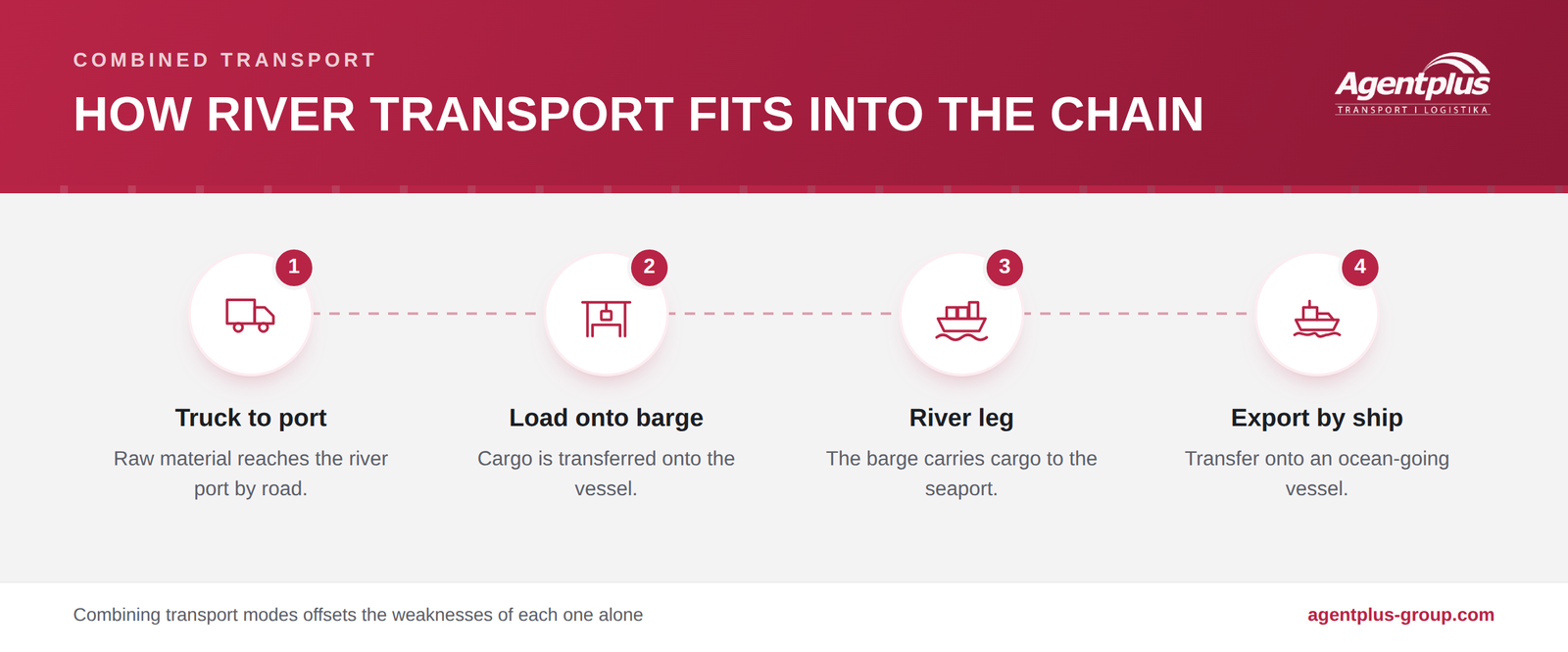
Infographic showing combined transport in four steps: truck to the river port, loading onto a barge, the river leg to the seaport, and export by an ocean-going ship

The most efficient logistics models today rarely use a single mode of transport. River transport is most often combined with rail and road transport.

Example of a combined flow:

  • transport of raw material by truck to the river port
  • loading onto a barge and transport to the sea port
  • transshipment onto a ship and export

This model is applied in Serbia and the region as well, especially for the export of agricultural products. It neutralizes the weaknesses of individual modes of transport and achieves an optimal balance of speed and cost.

Common mistakes in planning river transport

Many companies that are just introducing river transport make similar mistakes:

  • planning without checking seasonal water levels
  • insufficient analysis of total first- and last-mile costs
  • relying on a single operator at the port
  • incorrect estimation of loading and transshipment times

One of the most common misconceptions is that river transport is always slower. In practice, it is slow only on the water. When road congestion and border waiting are avoided, the total transit time can sometimes be comparable.

A practical example

Few people know that barges are often used as temporary storage space when market disruptions occur. If, for example, a change in grain prices is expected over the next few weeks, a barge can serve as a floating silo. This allows exporters to postpone transshipment to the optimal moment and achieve a better price. This technique is used only by operators with deep experience in river operations.

Frequently asked questions

Can river transport be used for container shipments?

It can, but cost-effectiveness depends on the route and the availability of container terminals at the ports. It works best on the main European river corridors.

How dependent is river transport on weather conditions?

It is highly dependent on water levels. During low water, barge capacity drops, while winter and ice can temporarily halt navigation.

Does river transport reduce CO₂ emissions?

Considerably. Barges consume less fuel per ton of cargo than trucks and trains, which significantly reduces the carbon footprint.

When does combined transport pay off the most?

It works best when river transport is used for the main part of the route, and road or rail for the first and last mile. This brings lower costs without a major loss of speed.

How to make the right decision

River transport offers a good balance between cost and reliability, but it is not a universal solution. It is worth introducing where there is a stable cargo flow, a good port nearby and a plan that takes seasonal water-level changes into account. The real benefit comes only when the entire chain is carefully measured, from loading to the final destination.

For companies that want expert support in assessing routes, optimizing combined transport or choosing a reliable operator, Agent Plus is at your disposal to help you reduce risk and speed up the entire process.

Conditions and Rules for Road Transport of Dangerous Goods

Road transport of dangerous goods is among the most delicate jobs in logistics. Even the smallest mistake can be costly. It is not only about money, but about human lives, environmental pollution and material damage. That is why the rules in this field are strict, and the work requires knowledge, experience and discipline. For the transport of dangerous goods by road, simply holding a permit is not enough. It is a complete system of rules that must function from the moment the goods leave the loading dock until they reach their destination.

Below we explain the key obligations, the measures you need to know, and the problems that companies and drivers face.

What road transport of dangerous goods involves

The basic idea behind all these regulations is to keep risk as low as possible. This is achieved through clear classification of goods, correct packaging and labeling, precise documentation, and training of the people who handle them.

How dangerous goods are classified

Under the ADR agreement, dangerous goods are divided into several classes. In road transport, the most common are:

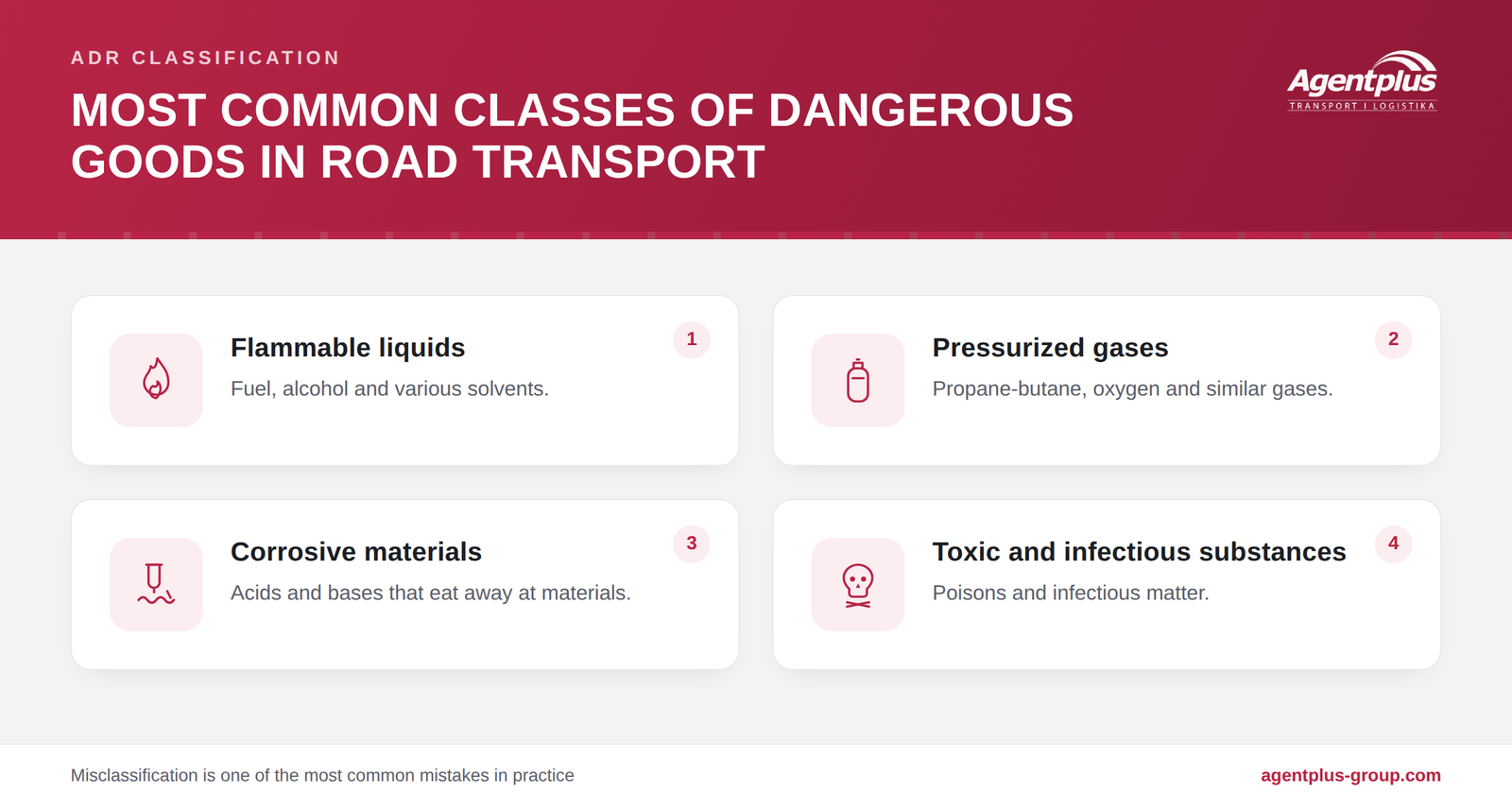
Infographic showing the most common ADR classes of dangerous goods in road transport: flammable liquids, pressurized gases, corrosive materials, and toxic and infectious substances

  • Flammable liquids – fuel, alcohol, various solvents
  • Pressurized gases – propane-butane, oxygen and similar
  • Corrosive substances – acids and bases that corrode materials
  • Toxic and infectious substances – poisons and infectious materials

Each of these classes requires a specific approach. One of the most common mistakes in practice is precisely the incorrect classification of goods. It later affects everything, from fines to a complete ban on transport.

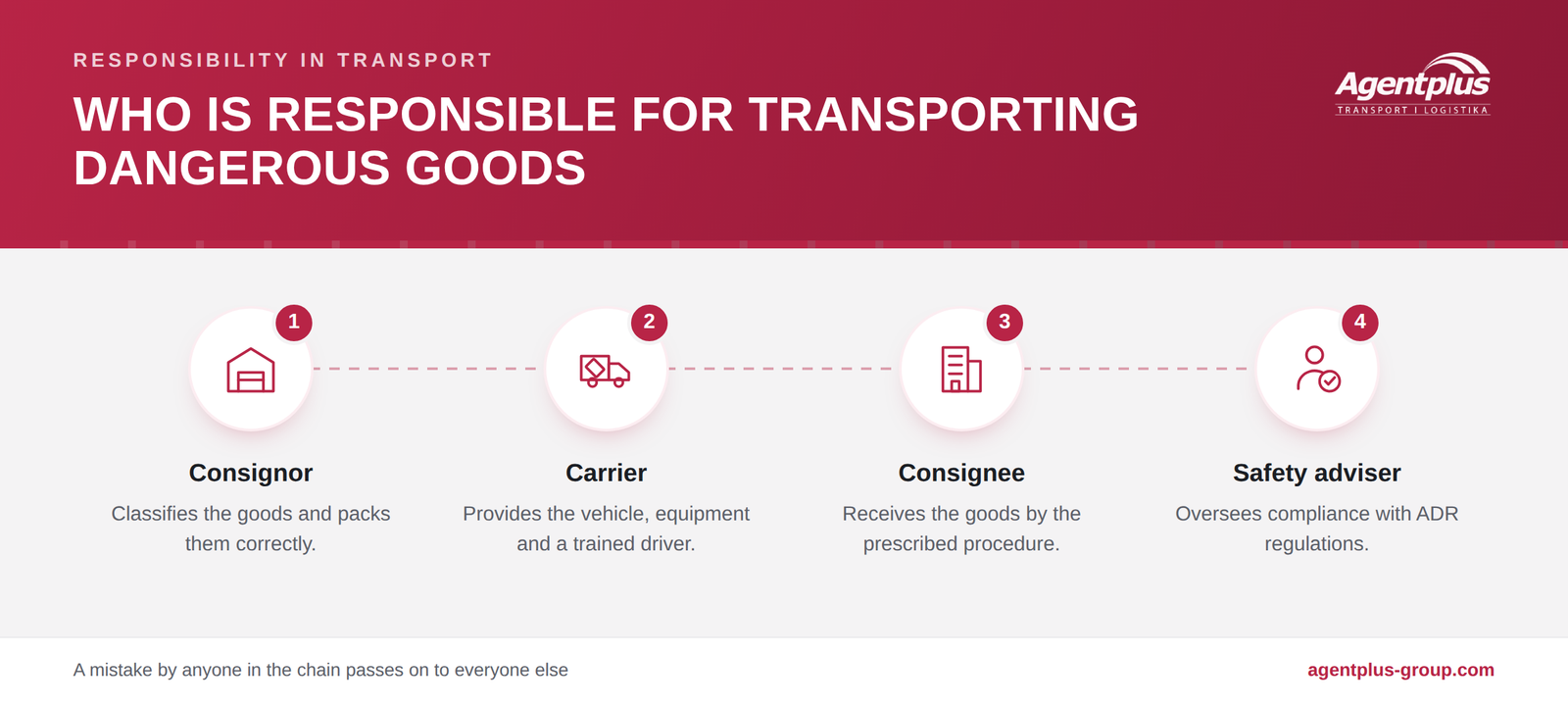
Who is responsible for the transport of dangerous goods

Infographic showing the chain of responsibility in dangerous goods transport: consignor, carrier, consignee, and safety adviser

In Serbia, ADR regulations apply together with domestic laws. Responsibility does not rest on the driver alone, as many people think. The transport chain involves:

  • the consignor of the goods
  • the carrier
  • the consignee
  • the safety adviser for the road transport of dangerous goods

If any of them makes a mistake, the problem quickly spreads to everyone else.

What must be met for legal transport

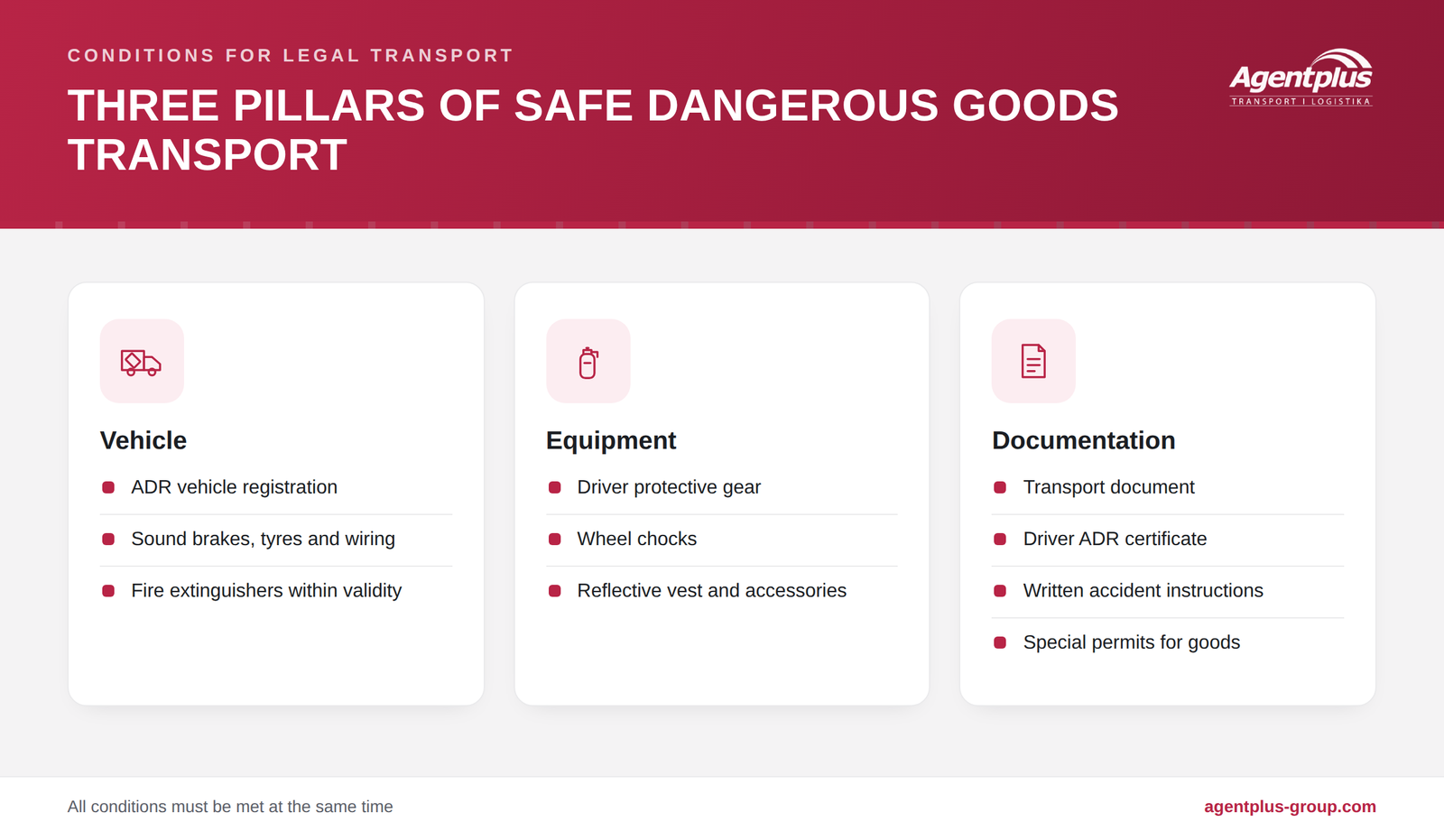
For the road transport of dangerous goods to be both legal and safe, a series of clearly defined conditions must be met.

Infographic showing the three pillars of safe dangerous goods transport: an adapted vehicle, mandatory equipment, and complete documentation

Vehicles must be adapted

Vehicles that transport dangerous goods are not ordinary. They must be technically matched to the type of cargo they carry. This includes:

  • a certificate that the vehicle is registered for ADR
  • functional brakes, tires and the entire electrical system
  • fire extinguishers of appropriate capacity and within their valid period

The problem arises when a vehicle formally meets the requirements, but its physical condition does not match the documentation. This is exactly what inspection checks.

Equipment that must be in the vehicle

The equipment that must be in the vehicle saves lives in a critical situation. It includes protective equipment for the driver, wheel chocks, a reflective vest, and written instructions on how to act in case of an incident.

The paperwork must be complete

For transport to be considered legal, the documentation must be complete. The following are most often required:

  • the transport document
  • the driver’s ADR certificate
  • written instructions in case of an accident
  • special permits for certain types of goods

A common mistake is to reuse old documentation for a new transport without checking whether it matches the cargo. This can be costly.

Why driver training matters

If the driver is not trained, the regulations mean nothing. The driver must understand exactly what they are transporting and how to react if something goes wrong.

ADR certificate

ADR training provides the basics, but real experience is gained in the field. Drivers who regularly handle the road transport of dangerous goods know that every type of cargo has its own specifics. The procedure for a corrosive liquid leak is completely different from that for a flammable substance.

What the driver must monitor during the trip

The driver is the first who must react in case of a problem. That is why it is important to:

  • regularly check the cargo during the trip
  • plan breaks carefully
  • avoid high-risk sections of the road whenever possible

Packaging, labeling and handling

One of the most common causes of accidents is poor packaging, so the best prevention is to pay attention to the following:

Packaging must be tested

Packaging must be tested and labeled according to standard. Improvised solutions are prohibited, even for transport over a short distance.

Proper markings

The orange plates and hazard symbols are not there for appearance. They allow emergency services to know at a glance what they are dealing with and how to respond.

Careful loading and unloading

In practice, this is where most problems occur. If the cargo is not properly secured, it can shift during transit, damage the packaging and cause a leak or fire.

The mistakes people make most often

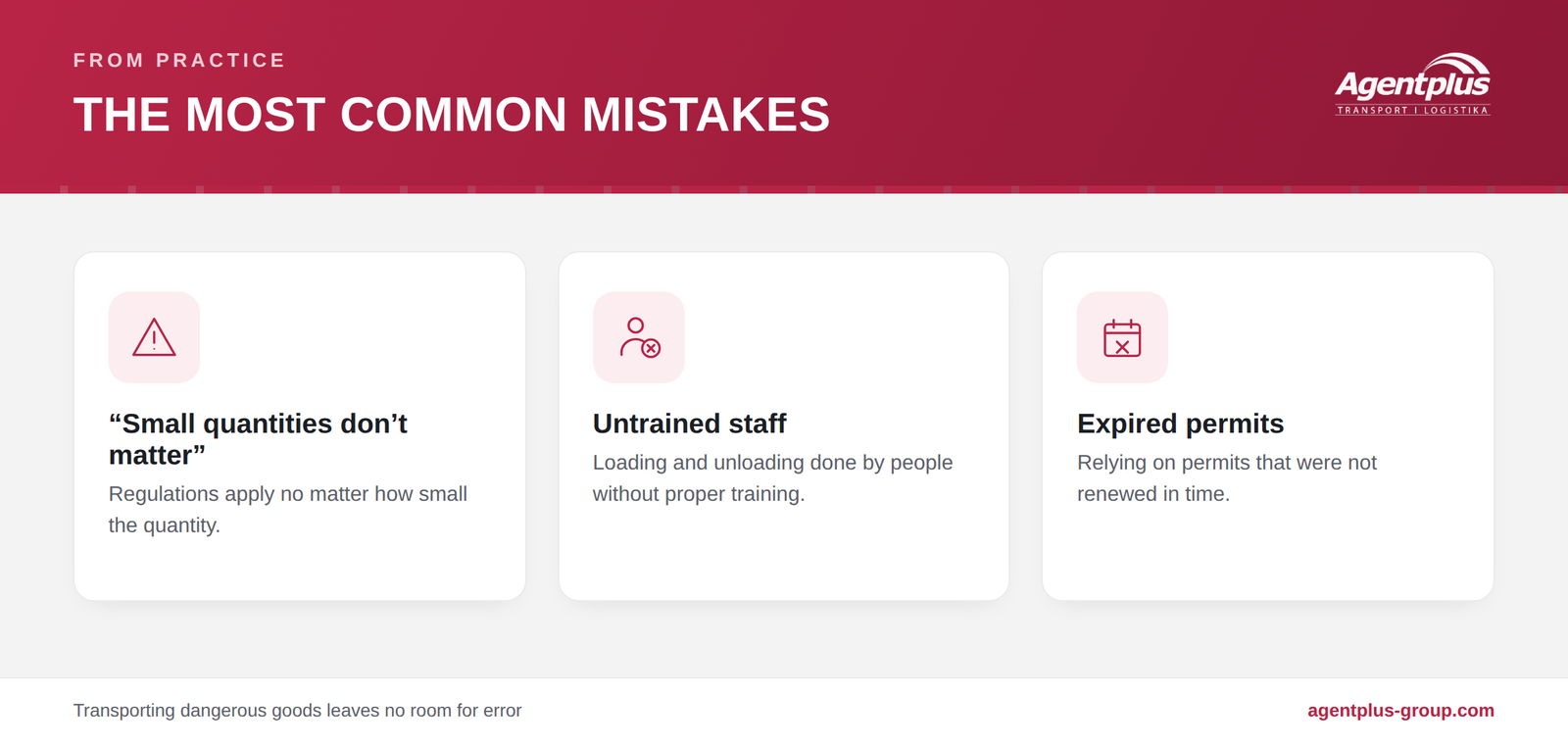
Infographic showing the most common mistakes in dangerous goods transport: underestimating small quantities, untrained staff, and expired permits

Experience from practice shows several mistakes that keep recurring:

  • the belief that small quantities are less important
  • using untrained staff for loading and unloading
  • relying on old permits that were not renewed on time

The road transport of dangerous goods does not forgive mistakes, no matter how small the quantity.

A tip from practice

Serious companies in this business keep an internal record of “near misses.” These are situations in which no accident occurred, but it came close. By analyzing such cases, real problems can be prevented. This is not a legal obligation, but it is common practice among companies that last on the market.

The importance of a good logistics partner

A good logistics partner can significantly reduce risk. Cooperation with specialized companies and advisers, such as Agent Plus, often means faster document preparation, better organization and fewer delays in the field, along with a higher level of safety in handling dangerous goods.

Frequently asked questions

Is ADR required for every dangerous good?

Not always. There are exemptions for small quantities, but the conditions for them must be met precisely.

Who pays the fine if the documentation is not in order?

In practice, the fine can hit both the carrier and the consignor, depending on the nature of the violation.

How often is the ADR certificate renewed?

The certificate is renewed periodically, with a mandatory knowledge check.

Do foreign carriers follow the same rules?

Yes. ADR applies internationally, but local additions may exist.