
River transport is still underused in practice, even though it is a very important factor in planning modern logistics chains.
River transport enables lower costs per ton, significant capacity and stable delivery, but it also comes with limitations in speed, seasonal dependence and the need for developed infrastructure. This mode of transport works well for bulk cargo over longer distances, while for urgent deliveries or areas without navigable waterways it is not an ideal solution. Below we explain in more detail the specific aspects and circumstances under which this choice becomes justified.
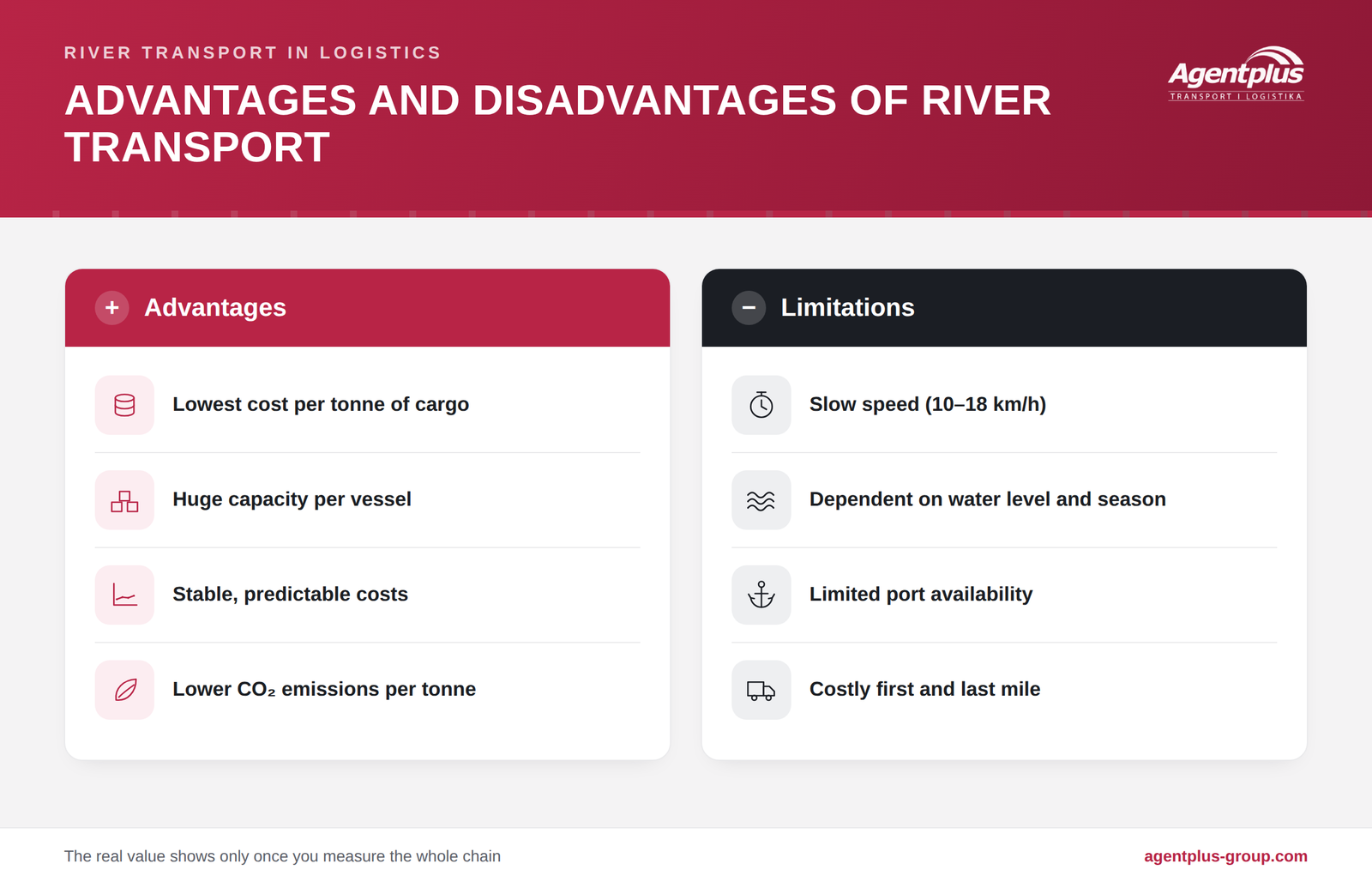
Advantages of river transport
Before you decide on river transport, it is important to understand what sets it apart from other modes and how those differences affect costs, delivery times and operational risks.
Key characteristics of river transport
This mode of transport is usually used for bulk and heavy cargo such as grain, ore, construction materials, industrial equipment and energy products. Several basic characteristics determine how it is planned:
- high capacity of individual vessels
- stable and predictable costs
- slower speed compared to road and rail transport
- sensitivity to water levels and seasonal changes
- the need for specialized transshipment infrastructure
The combination of these factors shows whether a stable schedule and a competitive price can be achieved on a specific river route.
Where the real savings come from
The most pronounced advantage of river transport lies in the ratio between capacity and cost. When comparing the price of transporting one ton of goods, barges in many cases offer the lowest price per kilometer. This brings two concrete benefits to logistics plans: lower direct costs and the ability to consolidate cargo in larger quantities.
A practical example is the export of grain from northern Serbia. Once the grain is loaded onto a barge on the Danube, the cost of transport to ports in Romania or Bulgaria often drops by up to 40% compared to truck transport, depending on the seasonal demand for road capacity.
Delivery stability and route predictability
Although river transport is slower, the delays that occur on road routes due to traffic congestion, driver shortages, movement bans and similar issues rarely happen. This makes it exceptionally reliable in industries where transit time is not decisive, but stability is key.
The differences are most visible in the steel and construction materials industries, where barges often function as mobile warehouses. Planning becomes simpler because routes and costs remain consistent throughout the navigation season.
Limitations of river transport
When analyzing the advantages and disadvantages of river transport, three main limitations stand out in practice:
1) Speed
River transport is among the slowest modes of inland transport. Barges move at a speed of 10 to 18 km/h, and even slower on some sections. This means this mode of transport is not suitable for urgent deliveries or products with a short shelf life.
2) Water levels and seasonality
The water level directly determines the draft depth and loading capacity. During the summer, when the water level is often low, barges can sometimes carry only 50 to 70% of standard capacity. In winter, the problem is ice.
For this reason, many companies plan key deliveries during periods of stable water levels and use combined transport for critical stock.
3) Limited port availability
River transport works only where there are ports, transshipment ramps and appropriate access infrastructure. If a factory or warehouse is not near a waterway, the costs of the first and last mile can cancel out all the savings.
When river transport is the best choice
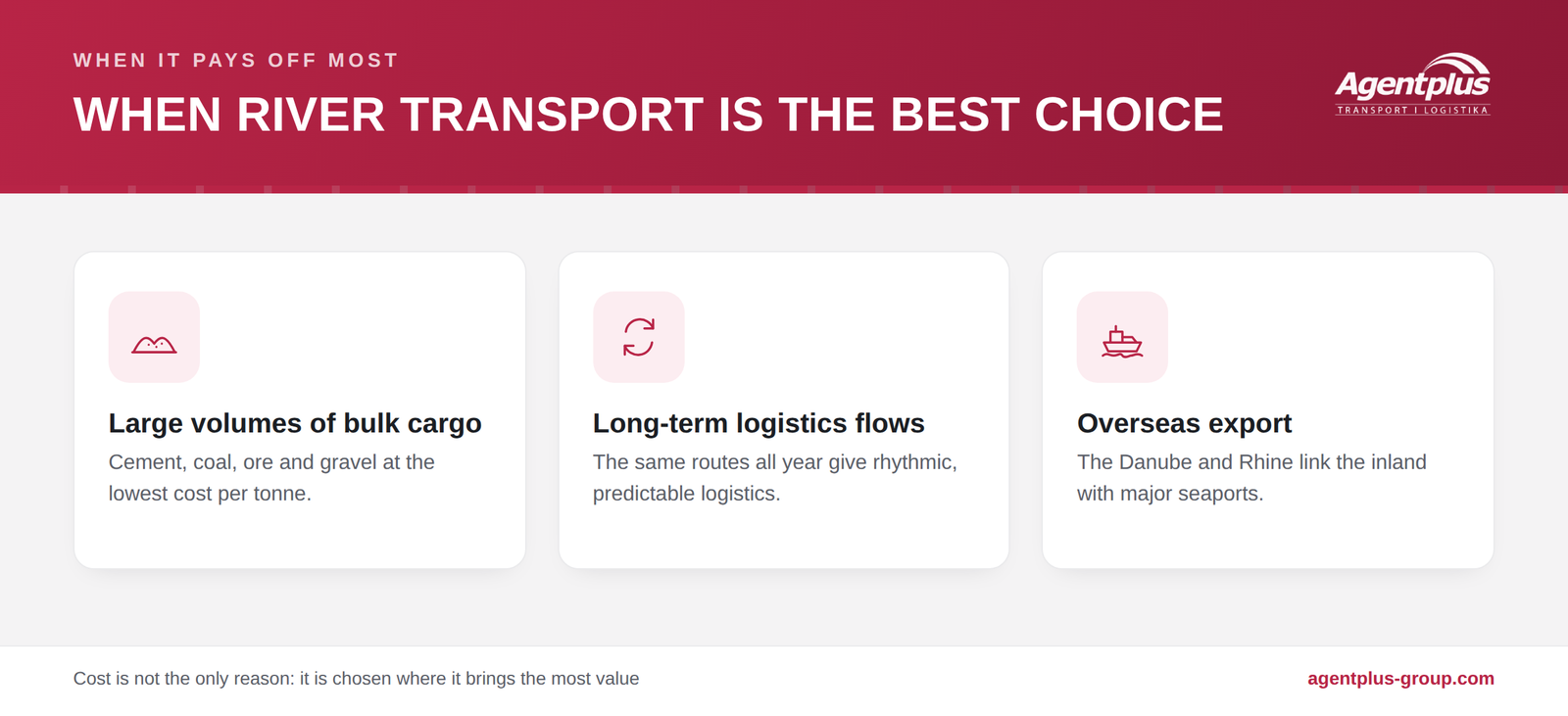
Price is not the only reason river transport is chosen. There are clearly recognizable situations in which it provides the greatest value:
Large quantities of bulk cargo
Barges can carry thousands of tons in a single trip, which gives a better price-to-capacity ratio than any other mode of transport. For products such as cement, coal, ore or gravel, river transport almost always leads to the lowest price per unit of cargo.
Long-term logistics flows
Products that move along the same route throughout the year, for example industrial raw materials, work best on rivers because the logistics become rhythmic and predictable.
Overseas export via river corridors
The Danube, the Rhine and similar waterways connect the interior of the continent with major sea ports. River transport here serves as an economical extension of the maritime chain.
How river transport is combined with other modes
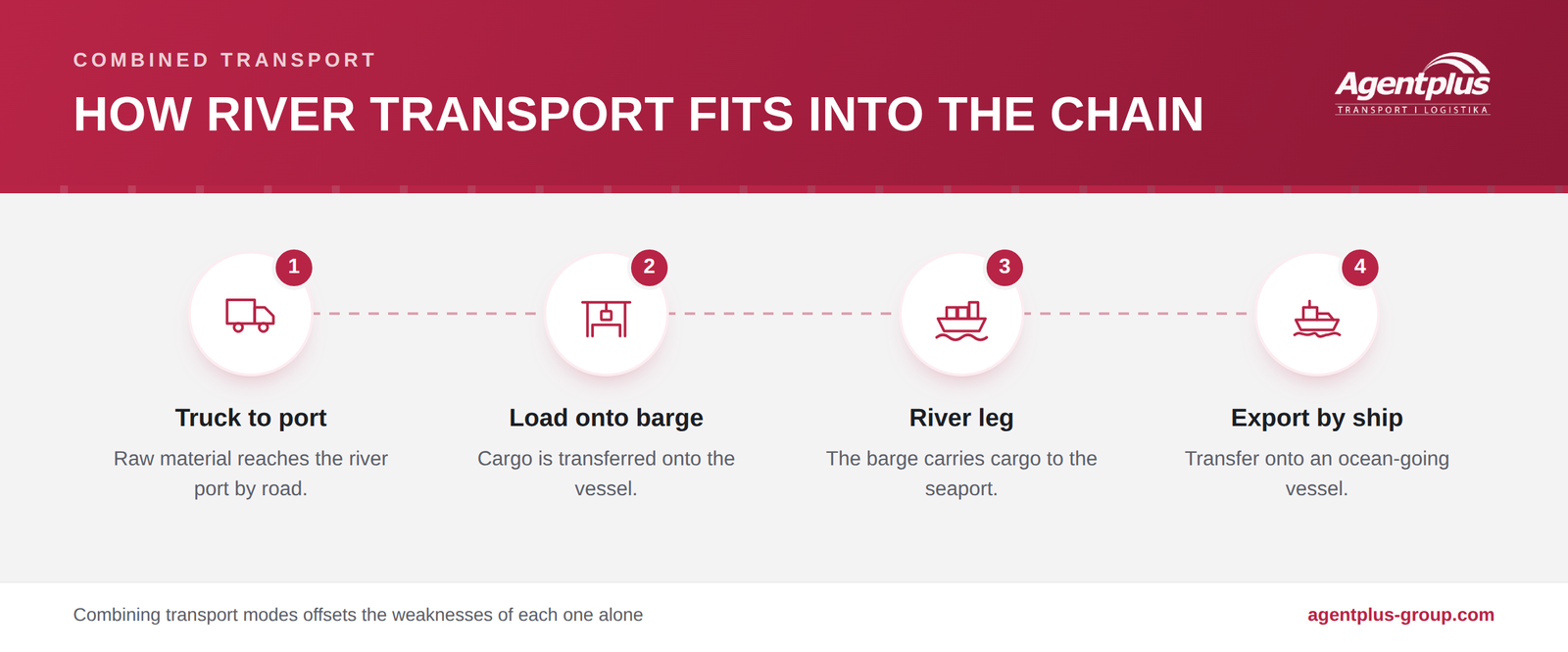
The most efficient logistics models today rarely use a single mode of transport. River transport is most often combined with rail and road transport.
Example of a combined flow:
- transport of raw material by truck to the river port
- loading onto a barge and transport to the sea port
- transshipment onto a ship and export
This model is applied in Serbia and the region as well, especially for the export of agricultural products. It neutralizes the weaknesses of individual modes of transport and achieves an optimal balance of speed and cost.
Common mistakes in planning river transport
Many companies that are just introducing river transport make similar mistakes:
- planning without checking seasonal water levels
- insufficient analysis of total first- and last-mile costs
- relying on a single operator at the port
- incorrect estimation of loading and transshipment times
One of the most common misconceptions is that river transport is always slower. In practice, it is slow only on the water. When road congestion and border waiting are avoided, the total transit time can sometimes be comparable.
A practical example
Few people know that barges are often used as temporary storage space when market disruptions occur. If, for example, a change in grain prices is expected over the next few weeks, a barge can serve as a floating silo. This allows exporters to postpone transshipment to the optimal moment and achieve a better price. This technique is used only by operators with deep experience in river operations.
Frequently asked questions
Can river transport be used for container shipments?
It can, but cost-effectiveness depends on the route and the availability of container terminals at the ports. It works best on the main European river corridors.
How dependent is river transport on weather conditions?
It is highly dependent on water levels. During low water, barge capacity drops, while winter and ice can temporarily halt navigation.
Does river transport reduce CO₂ emissions?
Considerably. Barges consume less fuel per ton of cargo than trucks and trains, which significantly reduces the carbon footprint.
When does combined transport pay off the most?
It works best when river transport is used for the main part of the route, and road or rail for the first and last mile. This brings lower costs without a major loss of speed.
How to make the right decision
River transport offers a good balance between cost and reliability, but it is not a universal solution. It is worth introducing where there is a stable cargo flow, a good port nearby and a plan that takes seasonal water-level changes into account. The real benefit comes only when the entire chain is carefully measured, from loading to the final destination.
For companies that want expert support in assessing routes, optimizing combined transport or choosing a reliable operator, Agent Plus is at your disposal to help you reduce risk and speed up the entire process.
Connect with our logistics team
Branch offices
AGENT PLUS SERBIA
- Adresa
- Makenzijeva 25, 11000 Beograd, Srbija
- Telefon
- Tel: +381 11 204 01 00
- E-mail: office@agp.rs
AGENT PLUS CROATIA
- Adresa
- Oreškovićeva 3, 10000 Zagreb, Hrvatska
- Telefon
- Tel: +38551312265
- E-mail: zagreb@agentplus.hr
AGENT PLUS MONTENEGRO
- Adresa
- Barskih logoraša 5b, 85000 Bar, Crna Gora
- Telefon
- Tel: +382 30 312 988
- E-mail: office@agentplus.me