
test engleskiTransport is a business full of uncertainty. Routes change, the weather is unpredictable, breakdowns happen, delays occur or mistakes are made. That is why the basic risks of transport insurance are worth considering before the goods set off.
When your goods are insured, you are in a more secure position if something goes wrong. Many cargo owners assume the carrier is liable for every loss, but the law regulates this differently. The carrier’s liability is limited, and that liability is often far lower than the actual value of the goods. That is why insurance is the only reliable way to receive full compensation if damage occurs.
What does transport insurance cover?
Transport insurance protects goods from problems that arise during road, sea, rail or air transport. These are mostly losses caused by circumstances beyond the control of both the carrier and the cargo owner.
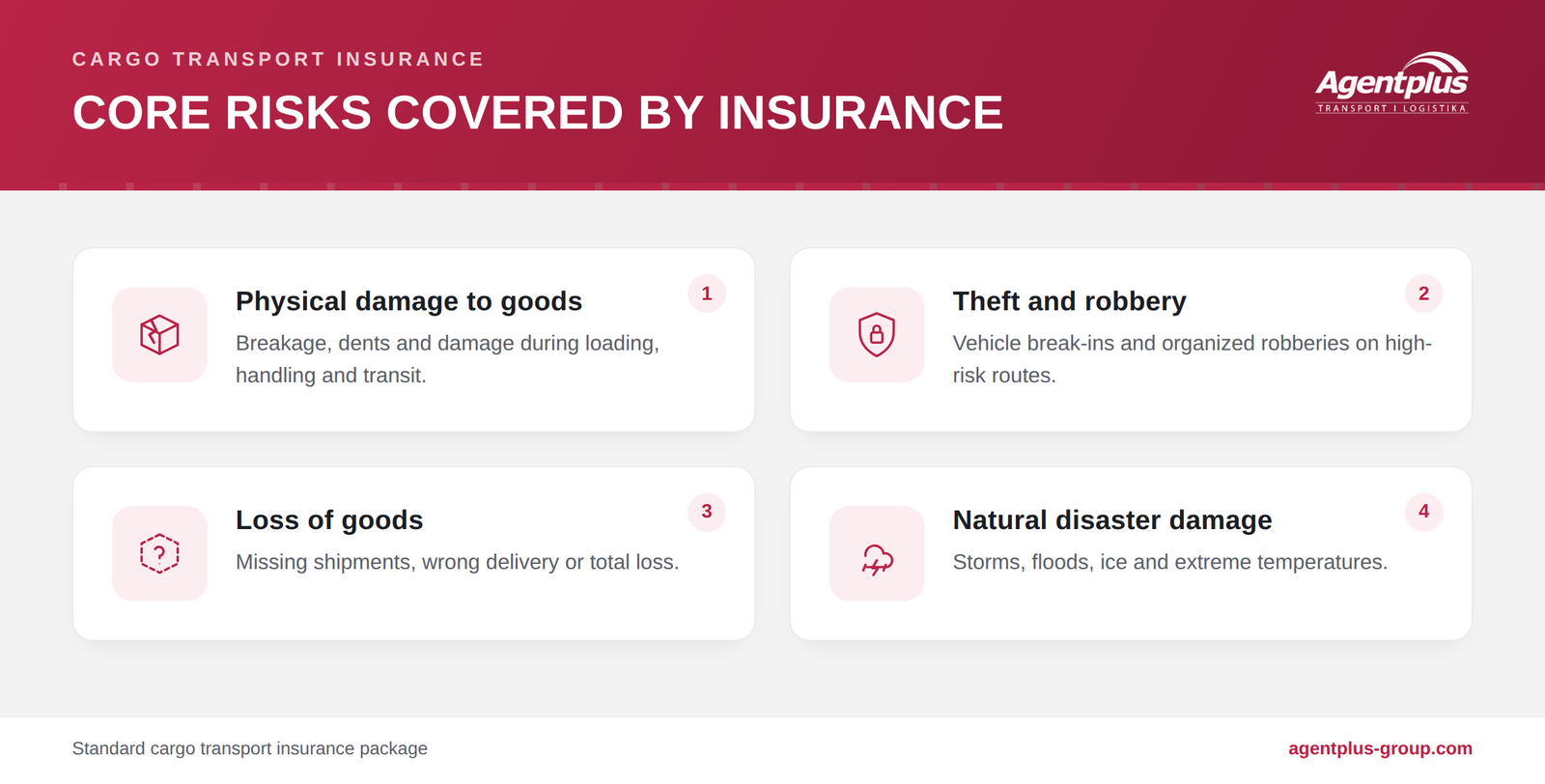
A basic insurance package usually covers four main groups of risks:
1. Physical damage to goods
Damage most often occurs during loading, handling or from vibrations while in transit. Glass packaging cracks, metal parts get dented, electronics suffer from impact. For high-value goods, even minor damage means significant losses, which makes this one of the most critical items in insurance.
2. Theft and robbery
Transport vehicles are a frequent target for theft. Longer routes, overnight stops, unguarded parking areas and passage through high-risk regions increase the chance that goods will go missing, in part or in full. Insurance covers both break-ins to the vehicle and organized robberies, which is especially important for electronics, textiles and pharmaceuticals.
3. Loss of goods
It happens rarely, but when it does, the consequences are serious. Loss can occur when:
- a container disappears entirely
- a delivery is sent to the wrong address
- a pallet falls from a crane at the port
- a ship sinks or a truck overturns
In such cases the loss is total, so it is important that the policy clearly covers total loss.
4. Damage from natural disasters
Storms, floods, landslides, heavy snow, extreme temperatures and ice can cause delays, damage packaging or spoil goods, especially in the case of temperature-sensitive products. A basic package usually covers the most common disasters, while extended protection is added for specific risks.
What does transport insurance look like in practice?
In practice, transport insurance for basic risks covers what is most likely to happen during ordinary transport. Wording differs from one insurer to another, so you should always check exactly what is covered.
A basic package most often includes:
- damage or breakage due to a traffic accident
- damage during loading and unloading
- loss or disappearance of goods
- fire and explosion
- theft by break-in
- packaging damage that directly affects the goods
For expensive goods, perishable goods or specific industries, a basic package is often not enough, but it is a good basis for understanding the risks.
Which risks are usually not covered by a basic policy?
This is where most misunderstandings arise. There is a belief that a policy covers everything that happens, but there are quite a few exceptions:
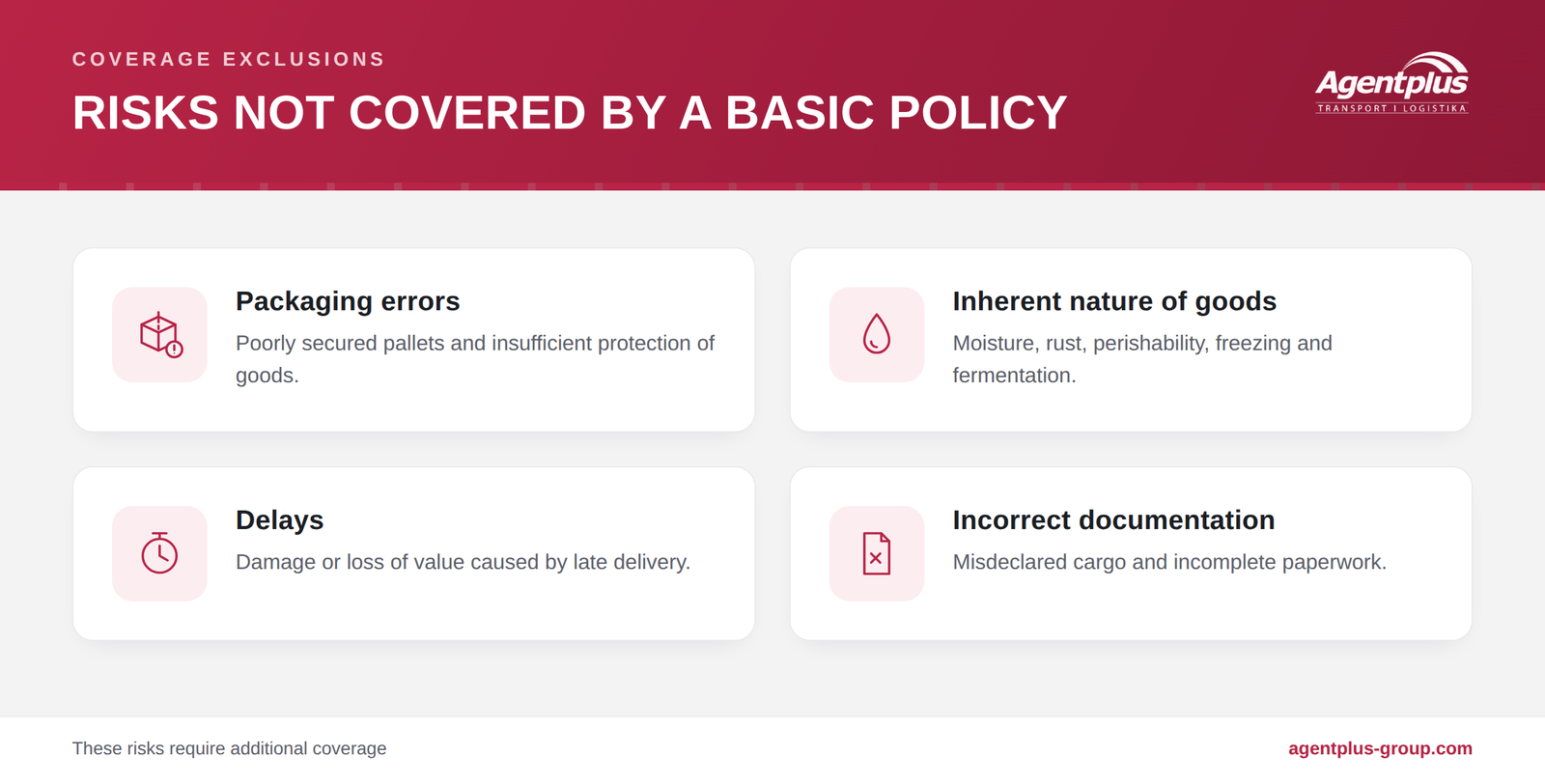
Packaging errors
If goods are poorly packed, overloaded or lack the necessary internal securing, the insurer may refuse compensation. The most common errors are poorly secured pallets, insufficient protective material and containers that are not properly closed.
The natural properties of goods
Moisture, rust, perishability, freezing and fermentation are especially critical for food and pharmaceutical products. For such goods, a special type of insurance is usually arranged.
Delays
Even when a delay leads to spoiled goods, a basic package most often does not cover it. This is one of the most common misunderstandings between cargo owners and carriers.
Incorrect documentation
Incorrectly declared cargo, incomplete papers or inaccurate data can lead to a refused claim.
When you check this in advance, you avoid a situation where you think you are protected while in fact you are not.
How to choose the right level of coverage?
A good policy depends on the value of the goods, the type of goods and the route. The combination of these three factors determines the actual level of risk.
Type of goods
Electronics, pharmaceuticals and textiles are the most common theft targets. Machinery and industrial equipment are often damaged due to their weight and sensitive components. Food items require controlled conditions and can lose quality even from a minor delay.
Length and complexity of the route
The longer and more complex the route, the greater the risk. Transport across several countries means customs checks, changes of carrier and passage through different climate zones. Each of these points is a place where something can go wrong.
Value of the shipment
For cheaper goods, a basic package is often entirely sufficient. For high-value goods, such as medical equipment or premium electronics, extended coverage and a higher insured amount are recommended.
What does the process look like when damage occurs?
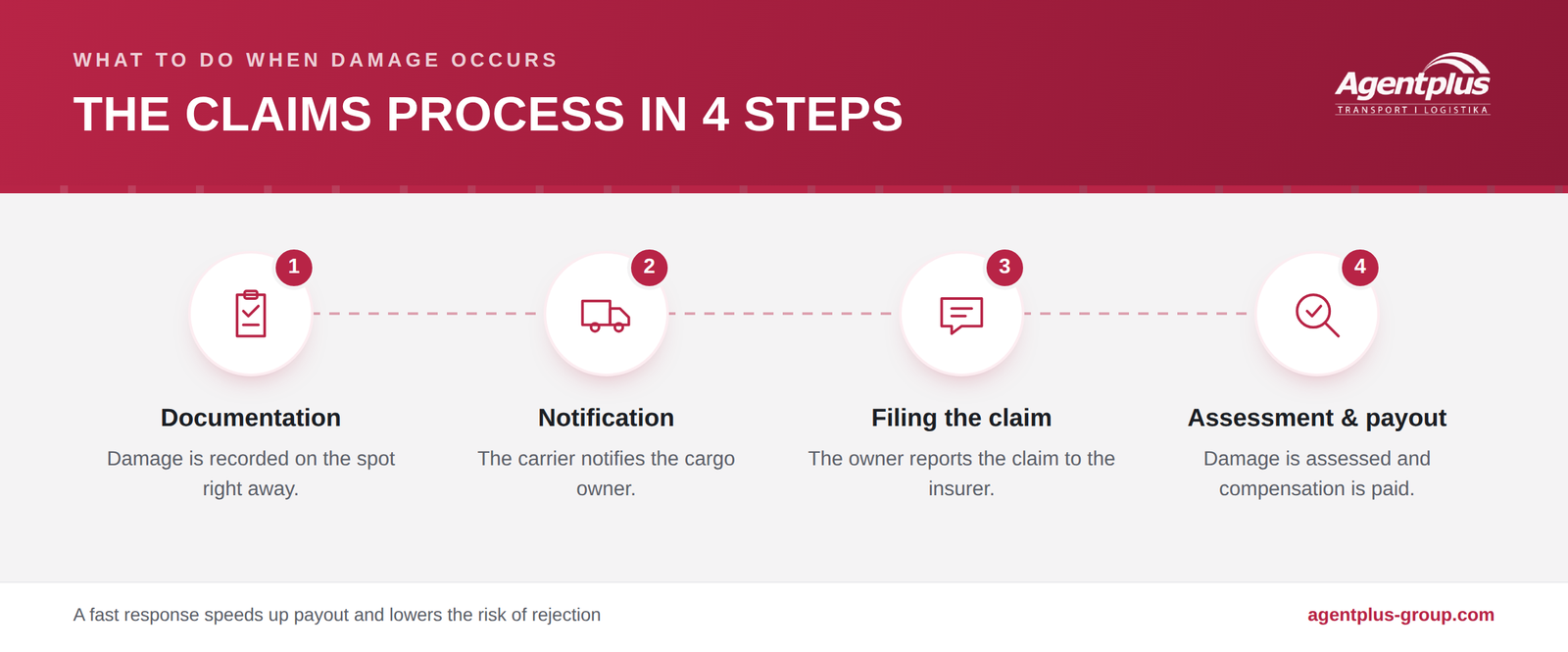
Experience shows that a quick response makes a big difference. The procedure usually goes as follows:
- the damage is documented immediately on the spot
- the carrier notifies the cargo owner
- the cargo owner notifies the insurer
- the damage is assessed and compensation is paid on that basis
Well-kept documentation speeds up the entire process and reduces the chance that a claim will be refused.
How experienced freight forwarders do it
Large freight forwarders often arrange policies based on annual volume rather than per shipment. This gives them a lower price and more flexible coverage. Small and medium-sized businesses rarely know that they can use the same option through a freight forwarding intermediary, who combines several clients under a single policy, with a more favorable price and broader coverage. For goods shipped regularly, this noticeably reduces costs.
Where is insurance usually arranged?
Insurance is most often arranged through logistics companies that handle international transport every day. They understand the risks in the field and know what can happen in practice. Agent Plus, with years of experience in transport and logistics, also offers insurance brokerage for goods in transport, which makes the job considerably easier for clients.
Frequently asked questions
Is insurance worth it for low-value shipments?
Yes, especially when you are shipping sensitive goods. The premium is usually small compared to the potential loss.
Does insurance cover damage from poor packaging?
No, improper packaging is usually treated as an exclusion from coverage.
Is insurance mandatory?
It is not required by law, but it is recommended for any goods that travel a longer distance or have significant value.
Can I insure goods for just one trip?
Yes, most insurers offer per-shipment policies, which is a good option for occasional transport.
How to choose the right protection?
Transport insurance is real protection against risks that can happen even to the best carriers. A clear understanding of the basic risks helps you choose a policy that covers exactly what you need.
It is best to assess the value of the goods, the route and the specifics of the cargo, and then choose a package that covers real risks rather than just minimum requirements. Experienced logistics partners can give you precise recommendations and prevent unnecessary costs or false expectations.
The right insurance choice protects your business, speeds up recovery from damage and prevents a single transport problem from turning into a major financial loss.
Connect with our logistics team
Branch offices
AGENT PLUS SERBIA
- Adresa
- Makenzijeva 25, 11000 Beograd, Srbija
- Telefon
- Tel: +381 11 204 01 00
- E-mail: office@agp.rs
AGENT PLUS CROATIA
- Adresa
- Oreškovićeva 3, 10000 Zagreb, Hrvatska
- Telefon
- Tel: +38551312265
- E-mail: zagreb@agentplus.hr
AGENT PLUS MONTENEGRO
- Adresa
- Barskih logoraša 5b, 85000 Bar, Crna Gora
- Telefon
- Tel: +382 30 312 988
- E-mail: office@agentplus.me